How to Become a Guide Runner
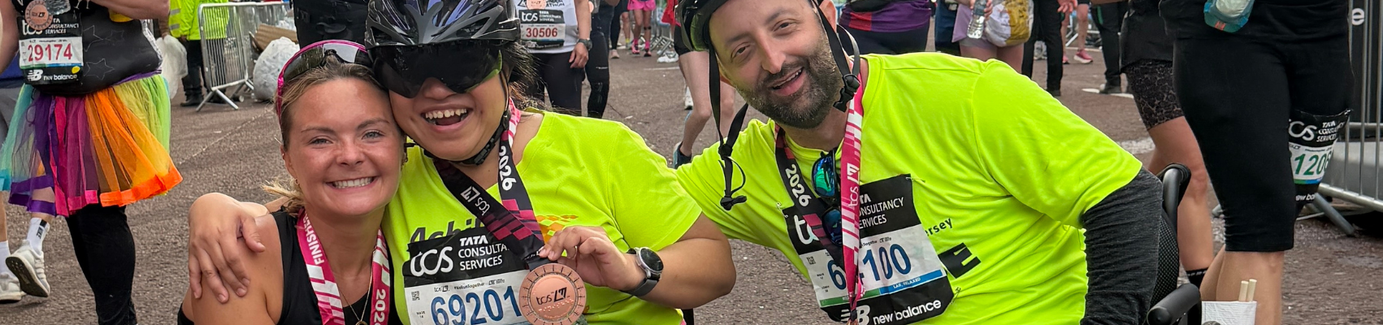
There's a point in every guiding partnership where it just clicks. You're one unit, moving together. That's the whole appeal of guide running for me. You don't have to be fast or fancy to do it. You just have to be patient, communicate well, and ready to support someone throughout their run; it’s for them, not you.
If you've been thinking about giving it a go, here's what I've learned about how it actually works.
So what does a guide runner actually do?
You're a sighted volunteer who runs next to a blind or visually impaired (VI) athlete and helps them get around safely - could be a chilled-out jog in the park, could be a 5K, could be a full marathon. Your job is to be their eyes: calling out what's coming up, describing the ground under their feet, keeping a steady pace. They're doing all the actual running. You're not dragging them along - think of yourself more like a navigation system that happens to have legs.
The basics you need to know
Tethers. Most pairs run connected by a short tether - about the length of your forearm. You hold one end loosely, they hold the other. It's not there for pulling anyone around. It's more like a subtle signal line for pace, direction, and "hey, we're turning here."
Holding the arm. Before or after a run, or if a runner just prefers it, they might hold onto your arm just above the elbow instead of using a tether. People call this "sighted guide." One thing to remember: they hold onto you - you don't grab them and steer.
Talking them through it. This is honestly the biggest part of the job. You're narrating everything ahead of time: "curb in three steps," "pothole on your left," "turning right at the corner," "runner coming up on your right." The trick is keeping it short, calm, and consistent - using the same phrases each time so they can react on autopilot instead of having to think about what you just said.
Touch cues, if you both want them. Some pairs also use a light touch on the arm to nudge someone back on course. Worth agreeing on this beforehand though - and never yank or grab unless something's genuinely about to go wrong.
Getting yourself ready
You don't need any kind of certificate to guide a friend or family member - you can just go run with them. But if you want to guide through a club or an official event, a lot of places run proper training for it. England Athletics and British Blind Sport, for instance, put on Sight Loss Awareness and Guide Running Workshop’s that walk you through different types of visual impairment, safety basics, and gets you actually practicing guiding (and being guided) with other people. I did one of these.
Even if you skip a formal course, there's a couple of things that genuinely help before your first real run:
Try being blindfolded. Get someone you trust to guide you on a slow jog while you can't see anything. It's a bit humbling, honestly, but it's the fastest way to understand what your runner actually needs from you.
Practice talking out loud on your own. Go for a solo run and just narrate what's around you as if someone were relying on it. It's surprising how much you normally tune out - cracks in the pavement, curbs, cyclists.
Have the conversation first. Before you take a single step together, sit down and ask what they prefer. Tether or arm hold? How much detail do they want from you? What's their usual pace? Are they fine with crowds, trails, busy roads? Don't assume - ask.
Once you're actually running together
A few things that make a real difference once you're moving:
Pay attention to everything, not just what's directly in front of you - elevation changes, stuff in your peripheral vision, people approaching. That's all on you to flag.
Keep your cues short. "Right turn ahead" - not a whole sentence.
Check in on how they're feeling, not just whether it's safe. A quick "how's the pace?" now and then keeps it feeling like a partnership rather than you just calling the shots.
If they're running with music, it's best if they leave one earbud out so they can still hear you and everything else going on around you.
Don't assume the last person you guided wants the same thing. Every VI runner is different - different type of vision loss, different preferences. What worked with one person might not work with the next.
Finding someone to guide
If you don't already know a VI runner, there are a few places that specifically match guides with athletes. These are the ones I have worked with, but there are plenty more.
England Athletics (Find a Guide) - probably the most well-known guide registry out there.
Achilles International - this charity regularly pairs up guides and athletes for training and races. I ran the London marathon with this team.
Local running clubs - a lot of them now have their own guide runner setups.
Usually it's a quick application, sometimes a background check, then they try to match you based on pace, location, and schedule.
Why I think it's worth it
Guiding is a partnership, and honestly you get as much out of it as the person you're running with. You end up on routes you never would've found, meet people you'd never have crossed paths with otherwise, and you probably become a more attentive runner yourself in the process. Some guide athlete pairs stick together for years, and that kind of trust - someone putting their hand on your elbow and knowing you've got them - is hard to find anywhere else in the sport.
If you can run, you can guide. All it really takes is showing up, paying attention, and being someone your runner can trust completely.